
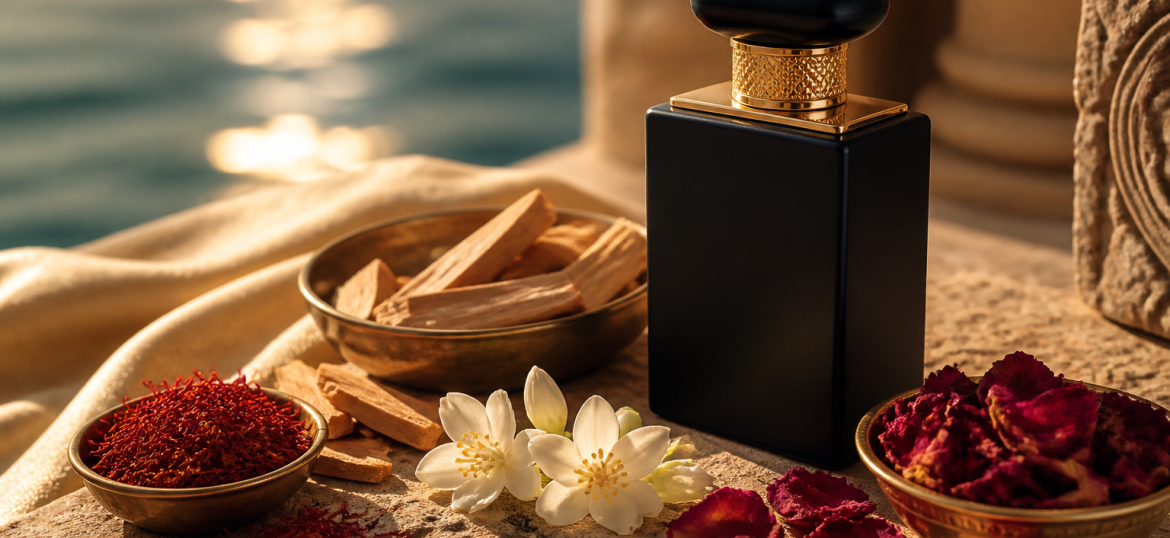
Quick answer: Indian luxury perfumes blend historically significant natural ingredients—such as sandalwood, vetiver (khus), jasmine, rose, saffron, cardamom, and oud—with modern fine-fragrance structure for richer texture, distinctive drydowns, and scent stories rooted in Indian perfumery.
Indian Luxury Perfumes: How Heritage Ingredients Shape Modern Scent
Indian luxury perfumes are having a quiet, well-earned moment. Not because nostalgia suddenly became fashionable, but because modern wearers are looking for fragrance with texture, memory, and meaning. Sandalwood that softens rather than shouts. Vetiver that cools the skin. Jasmine that feels luminous after dark. These are not trends invented on social media—they are materials India has refined for centuries, now reinterpreted through contemporary luxury perfumery.
If you have ever wondered why a saffron opening feels so magnetic, or why a patchouli drydown can feel both earthy and polished, this guide is for you. We will walk through the history of Indian perfume ingredients, how they work in premium compositions, and how to choose a fragrance that respects heritage without smelling dated.
Table of Contents
- Why Indian Perfumery Is Gaining Global Recognition
- The Rich History of Indian Fragrance Traditions
- Premium Indian Ingredients Used in Luxury Perfumes
- Sandalwood
- Vetiver (Khus)
- Jasmine
- Rose
- Saffron
- Cardamom
- Patchouli
- Oud in Modern Indian Perfumery
- How Modern Perfumers Blend Traditional Ingredients
- Benefits of Natural Indian Ingredients
- How to Choose an Indian Luxury Perfume
- Why Extrait de Parfum Makes a Difference
- Frequently Asked Questions
- Conclusion
Why Indian Perfumery Is Gaining Global Recognition
Luxury buyers have become sharper readers of ingredient lists. They ask where a material comes from, how it behaves on skin, and whether a composition has character beyond a familiar “fresh” or “sweet” template. That curiosity has opened doors for Indian perfumery on a global stage—across India, the UAE, the UK, and the USA.
Three forces are behind this shift:
- Material authenticity: Sandalwood, vetiver, jasmine sambac, and saffron carry sensory profiles that are difficult to replace with generic aroma chemicals alone.
- Cultural storytelling done properly: Wearers want provenance without costume. The best luxury Indian fragrances honor tradition without becoming theatrical.
- Cross-cultural dressing codes: Professionals moving between boardrooms in Mumbai, Dubai, London, and New York need scents that project refinement in multiple climates and social settings.
Niche fragrance collectors have also pushed demand for woodier, spicier, and more resinous profiles. Indian perfume ingredients sit naturally in that vocabulary. They offer depth without requiring an aggressive “oud bomb” aesthetic unless that is exactly what you want.
Expert insight: recognition grows when heritage materials are treated with modern drafting skill—cleaner openings, controlled sweetness, and drydowns that remain elegant after six to eight hours of wear.
The Rich History of Indian Fragrance Traditions
Fragrance in India has never been only decorative. Temple rituals, royal courts, bridal rituals, monsoon cooling practices, and trade with Arabia and Europe all shaped how scent was made and worn. Kannauj, often called a historic center of attar craft, developed hydro-distillation methods in which flower oils are absorbed into sandalwood base oil. The result is less about loud projection and more about gradual, intimate radiance.
Key ideas from Indian fragrance traditions still influence luxury perfume today:
| Traditional practice | Modern luxury parallel |
|---|---|
| Attar (oil-based perfume) | Oil-rich, skin-close compositions and dense extrait textures |
| Season-led scent dressing | Climate-aware perfume choices (vetiver for heat, woods for cooler evenings) |
| Floral absolutes from night-harvested blooms | Jasmine and tuberose facets in high-end fine fragrance |
| Spice as ritual and hospitality | Saffron and cardamom as signature top or heart accents |
History matters because it explains preference. Indian luxury perfumes often lean into warmth, floral richness, and woody calm—not because they cannot be fresh, but because their heritage materials are most eloquent when given room to bloom.
External reading tip: encyclopedic entries on sandalwood, jasmine, and saffron are useful for botanical context; treat brand myths and unverified “ancient formula” claims with caution.
Premium Indian Ingredients Used in Luxury Perfumes
Natural perfume ingredients from the Indian subcontinent often work as both odorants and “architectural” materials—meaning they shape the whole perfume’s silhouette, not only one fleeting note.
Below is a practical map niche collectors and first-time luxury buyers can use.
| Ingredient | Olfactory family | Typical role | Mood on skin |
|---|---|---|---|
| Sandalwood | Woody milky | Base / fixative character | Soft, creamy, serene |
| Vetiver (khus) | Woody earthy | Heart–base bridge | Cool, green, polished |
| Jasmine | White floral | Heart | Narcotic, luminous |
| Rose | Floral | Heart | Elegant, romantic, or spicy-rose |
| Saffron | Spicy leathery | Top–heart | Warm, radiant, slightly metallic |
| Cardamom | Spicy aromatic | Top–heart | Fresh-spicy, refined |
| Patchouli | Earthy woody | Heart–base | Camphorous to chocolatey |
| Oud (agarwood) | Woody animalic resinous | Heart–base | Smoky, deep, complex |
Many premium fragrances combine two or three of these rather than starring only one. That is how modern Indian luxury perfumes avoid smelling like a single raw material sample.
Sandalwood
Sandalwood is the quiet cornerstone of Indian luxury perfumes. High-quality sandalwood profiles often feel creamy, slightly sweet, and softly woody—less “pencil shavings,” more warm satin. In a perfume pyramid, sandalwood commonly sits in the base and helps florals and spices settle gracefully.
How modern wearers experience it:
- As a soft-focus woody aura behind rose or jasmine
- As a calm counterpart to saffron or leather facets
- As a refining finish in unisex woody compositions
Practical tip: if you find many wood fragrances too dry or smoky, look for sandalwood-forward perfumes with milkier, creamier language in the notes list. A well-built sandalwood perfume can feel formal enough for work and gentle enough for evening.
Collectors often compare Mysore-associated sandalwood character with other regional profiles. Exact sourcing labels vary by house and supplier ethics; what matters on skin is balance—no harsh sawdust dryness, no sticky vanilla overload pretending to be wood.
Internal example: compositions with sandalwood drydowns, such as velvet floral-woody styles found in bouquets like Grandiflora, show how woods can support rose rather than compete with it.
Vetiver (Khus)
Vetiver—khus in India—is distilled from grass roots. That simple botanical fact explains its scent: earthy, smoky-green, sometimes grapefruit-pith bitter, sometimes hazelnut warm depending on origin and distillation. In luxury Indian fragrances, vetiver is prized for heat-weather elegance. It cools without smelling like a cologne cliché.
Why perfumers reach for it:
- It bridges citrus openings into woody bases
- It adds spine to floral hearts
- It feels modern in both men’s and women’s wardrobes
If you live in humid climates (common for India, UAE summers, and warm US cities), a vetiver perfume can outperform gourmands that turn heavy by midday. Spray lightly on pulse points, give it ten minutes, and notice how the green-woody facet becomes cleaner as top brightness fades.
Style pairing tip: vetiver loves citrus, iris, soft florals, and pale woods. It is less forgiving next to sticky caramel notes unless the formula is expertly edited.
Jasmine
Indian jasmine—especially jasmine sambac—is night-bright and full-bodied. Where some European jasmine treatments can feel sheer or tea-like, sambac often feels rounder and more narcotic. In luxury perfume, jasmine is rarely “pretty only.” It can be green, fruity-indolic, or solar depending on the concentrate and companions.
Wearability guidance:
- Day: jasmine lifted with citrus, tea, or soft musks
- Evening: jasmine with woods, amber, or subtle spice
- Office: choose compositions where jasmine is polished, not animalic
Jasmine perfume lovers should smell the heart phase carefully. Many bottles smell cheerful in the first minute and then reveal the true floral personality after fifteen minutes on skin. That patience is part of shopping premium fragrances well.
Rose
Rose in Indian perfume culture ranges from fresh gulab-water brightness to deep, spicy rose used in richer oils. Modern luxury compositions may use Turkish or Bulgarian rose qualities alongside Indian floral traditions, then place them into contemporary structures.
Rose styles you may notice:
- Sheer rose: transparent, modern, good for daily wear
- Spiced rose: clove/cardamom/saffron adjacency for evening presence
- Woody rose: rose over sandalwood or patchouli for lasting polish
A frequent collector lesson: rose becomes “luxury” when it has texture—pepper, tea, honeyed petals, or incense shadows—rather than a single shampoo-like floral tone. That is also how luxury Indian fragrances keep rose adult and memorable.
Saffron
Saffron is one of the most persuasive Indian perfume ingredients in contemporary niche fragrance. On blotter it can read leathery, honeyed, metallic, and warm all at once. In a finished perfume, a little goes far. Overdosed saffron can feel dusty or medicinal; well-dosed saffron feels radiant and expensive.
Where saffron shines:
- Opening statements that feel precious without sugary sweetness
- Leather-amber compositions that need gold light rather than smoke
- Oriental florals that need lift above the wood base
If you are exploring saffron perfume for the first time, start with formulas where saffron shares space with rose, woods, or soft resins. Pure “spice cabinet” effects are less versatile for daily professional wear.
Internal example: saffron-leaning openings appear in darker floral-oriental styles such as Convict and in oud-spiced directions like OUD’s Bursts.
Cardamom
Cardamom is India’s elegant answer to “fresh spice.” Compared with cinnamon’s heat or clove’s sharpness, cardamom often feels cooler, greener, and more aromatic. In premium fragrances, it polishes citrus tops and gives woody hearts a modern contour.
Best uses in a wardrobe:
- Morning confidence without aggressive sport notes
- Warm-weather spice that will not choke in humidity
- A bridge between citrus and sandalwood or patchouli
Cardamom pairs beautifully with rose, lavender nuances, tea effects, and pale woods. If your fragrance wardrobe currently skews either only fresh or only heavy oriental, a cardamom-forward scent is often the smart middle path.
Internal example: cardamom’s spicy clarity is central to architectural woody profiles like Arch.
Patchouli
Patchouli has a reputation problem it does not deserve. Older associations with heavy oils ignore how refined modern patchouli fractions can be—cleaner, more chocolatey, less musty. In Indian luxury perfumes and in international fine fragrance alike, patchouli often supplies both earth and polish.
Think of patchouli as a versatile base language:
- With rose: couture depth
- With vanilla: gourmand sophistication
- With citrus: unexpected modernity
- With oud or resins: denser evening wear
If you smelled a patchouli twenty years ago and disliked it, re-test contemporary formulas. Ingredient processing and formula editing have changed the experience significantly.
Oud in Modern Indian Perfumery
Oud (agarwood) sits in a special place in modern Indian and West Asian luxury culture. Historically valued across regions connected by trade and taste, it now appears in everything from boutique extrait launches to more approachable woody-aromatic blends.
Important nuance for buyers: “oud perfume” can mean very different things.
| Style | Character | Best for |
|---|---|---|
| Raw/intense oud | Smoky, animalic, resinous | Collectors, evening, cooler air |
| Spiced oud | Oud framed by saffron/nutmeg | Statement wear, formal nights |
| Soft oud / oud suggestion | Woody depth without heavy smoke | Daily luxury, office-adjacent evenings |
| Floral oud | Oud under rose/jasmine | Unisex elegance |
Responsible luxury houses treat oud as a material to respect—not a volume contest. Sustainable and regulated supply matters; so does formula balance. The best modern interpretations keep complexity while remaining wearable.
If you are new to oud, sample in warmer conditions and on skin, not only paper. Oud drydowns transform more than most citrus florals, and that evolution is half the pleasure.
For a deeper look at modern aromatic-woody oud character, see OUD’s Bursts in the Venus Maris range.
How Modern Perfumers Blend Traditional Ingredients
Heritage materials alone do not create modern luxury. Draftsmanship does. Contemporary perfumers use traditional Indian ingredients inside a classic top–heart–base structure, then edit for clarity and diffusion.
A common modern approach:
- Bright opening: citrus, light spice, or aldehydic shimmer for lift
- Cultural heart: jasmine, rose, saffron, or cardamom as identity
- Resilient base: sandalwood, vetiver, patchouli, soft musk, or carefully dosed oud
- Texture control: musks and transparent woods to prevent muddiness
Expert insight: the mark of skilled blending is contrast without conflict. Saffron should not quarrel with jasmine. Vetiver should cool woods rather than turn them bitter. Sandalwood should soothe florals rather than flatten them into cream.
You can train your nose by smelling compositions thirty minutes apart. Ask: what remains when the fireworks fade? That remaining signature is where Indian perfume ingredients often do their finest work.
Application also changes perception. Moisture extends wood and floral hearts; dry skin may need a slightly richer concentration or a short layering routine. For practical placement tips, the Venus Maris guide on where to apply perfume pairs well with ingredient-focused shopping. If you enjoy customizing signatures, fragrance layering techniques can help you combine a sandalwood base with a saffron-rose accent carefully—two complementary scents maximum for beginners.
Benefits of Natural Indian Ingredients
Natural materials are not automatically “better,” and synthetic aroma chemicals are not automatically “cheap.” Modern luxury chemistry uses both for safety, consistency, and artistry. Still, premium Indian natural perfume ingredients offer clear sensory benefits when sourced and formulated well:
- Distinctive drydowns: real sandalwood and vetiver leave identifiable trails that feel less interchangeable
- Emotional resonance: floral and spice notes associated with ceremony and home memory deepen attachment to a bottle
- Versatile climate performance: khus and woody-florals often behave gracefully in heat compared with heavy gourmands
- Layering potential: shared musk, wood, or floral bases make curated wardrobes easier to build
Be wary of absolute claims. Natural does not guarantee hypoallergenic performance. Always patch-test if you have sensitivities, and treat brand “chemical-free” marketing with skepticism—perfume is chemistry by definition, whether botanical or lab-made.
What quality houses aim for is transparent stewardship: beautiful materials, responsible dosing aligned with industry standards such as IFRA guidance, and formulas that age gracefully in bottle and on skin.
How to Choose an Indian Luxury Perfume
Choosing among luxury perfumes India shoppers and diaspora buyers encounter can feel overwhelming. Use a decision path instead of a note bingo card.
Step 1: Decide your primary purpose
- Work and travel
- Evening and events
- Signature everyday scent
- Collection / niche exploration
Step 2: Match climate and concentration
Hot humid days favor vetiver, citrus-spice, pale woods, and translucent florals. Cooler evenings open space for saffron, denser rose, patchouli, and oud.
Step 3: Choose a dominant family
| If you like… | Start with… |
|---|---|
| Soft creaminess | Sandalwood perfume styles |
| Green cool woods | Vetiver perfume styles |
| Romantic florals | Jasmine or rose-forward blends |
| Golden spice | Saffron accents |
| Deep resinous woods | Modern oud compositions |
Step 4: Test like a collector
Smell on skin. Wait. Revisit after coffee or lunch. Projection in the first five minutes is not the whole story. Look for elegance in the mid-wear phase—that is when best Indian perfumes separate themselves from loud, short-lived sprays.
Step 5: Read the wardrobe gap
If your shelf already has three fresh aquatics, a cardamom-woody or saffron-rose composition may serve you better than another citrus.
A practical shortlist for beginners building a refined rotation:
- One sandalwood or soft woody daily
- One jasmine/rose evening floral
- One saffron-spice or oud option for statements
Browse curated selections via the Venus Maris shop, including For Him and For Her edits for quicker filtering.
Why Extrait de Parfum Makes a Difference
Extrait de Parfum generally refers to a higher concentration of perfume oils in the finished formula compared with eau de toilette or many eau de parfum styles. Exact percentages vary by house; there is no single global legal percentage stamped on every bottle. What wearers usually notice is denser texture, closer-to-skin richness, and longer perceptibility of the heart and base.
Why this matters for Indian luxury perfumes:
- Sandalwood, saffron, jasmine absolutes, and oud facets often express more nuance at richer concentrations
- Extrair-style wear can feel more intimate in professional spaces than a loudly diffusive edt
- Heavier materials may need balanced structure so richness does not become opaque
Shopping advice:
- Do not assume “extrait” automatically means “better.” Composition quality beats concentration labels.
- If you overspray rich formulas, you may blunt detail. Two short sprays on pulse points can outperform five sprays of a lighter concentration.
- Reapply strategically rather than saturating fabric and skin at once.
Whether a bottle is labeled extrait or not, evaluate longevity and sillage relative to your climate and wardrobe needs. For many premium fragrance wearers, a polished eau de parfum with excellent materials outperforms a poorly balanced “high concentration” claim.
Frequently Asked Questions
What are Indian luxury perfumes?
Indian luxury perfumes are fine fragrances that use—or are creatively inspired by—heritage materials and aesthetic traditions associated with Indian perfumery, such as sandalwood, vetiver, jasmine, rose, saffron, cardamom, patchouli, and oud. They may be crafted for global markets while keeping those sensory codes.
Which Indian perfume ingredients are most important?
Sandalwood, vetiver (khus), jasmine, rose, and saffron are among the most influential. Cardamom, patchouli, and oud extend the palette into spice, earth, and resinous woods.
Are natural Indian ingredients better than synthetics?
Not automatically. Naturals provide distinctive character; aroma chemicals provide consistency, safety editing, and modern transparency. The best luxury perfumery uses both thoughtfully.
How do I choose sandalwood vs oud?
Choose sandalwood if you want creamier, calmer woods for frequent wear. Choose oud if you want denser, smokier, more dramatic evening presence. Soft oud hybrids can sit between the two.
Do Indian-inspired fragrances work in Western offices?
Yes—when formulated with clarity. Cardamom-woody, vetiver, polished jasmine-musk, and soft sandalwood profiles travel well in UK and US professional settings. Keep spray count modest and favor refined compositions over heavily sweet or aggressively animalic styles.
What is the difference between attar and modern spray perfume?
Attars are traditionally oil-based and often worn intimately. Modern spray perfumes are usually alcohol-based fine fragrances designed for broader diffusion. Many luxury houses borrow attar’s rich material language while retaining spray convenience.
Can I layer Indian perfume ingredients at home?
Yes, cautiously. Pair families that already share a bridge note (for example, sandalwood with rose, or saffron with woody musk). Avoid stacking multiple heavy resins at once. See Venus Maris’s layering guide for technique.
Conclusion
Indian luxury perfumes succeed today because they offer something the market quietly craves: scent with ancestry and editing skill. Sandalwood steadies. Vetiver cools. Jasmine and rose give bloom. Saffron and cardamom add light and spice. Patchouli and oud deepen the story when the moment calls for drama.
If you are building a thoughtful wardrobe, start with one ingredient family that feels like you—then explore how modern perfumers weave that material into cleaner, contemporary structures. Smell slowly. Judge the drydown. Choose craftsmanship over loudness.
Venus Maris approaches perfume with that same respect for material character and timeless elegance: compositions shaped for people who want presence without noise, and beauty that feels considered rather than costume. Explore the collection when you are ready to translate heritage notes into a signature you can wear across cities, seasons, and chapters of life.